Business novel
Twelve Minutes Early
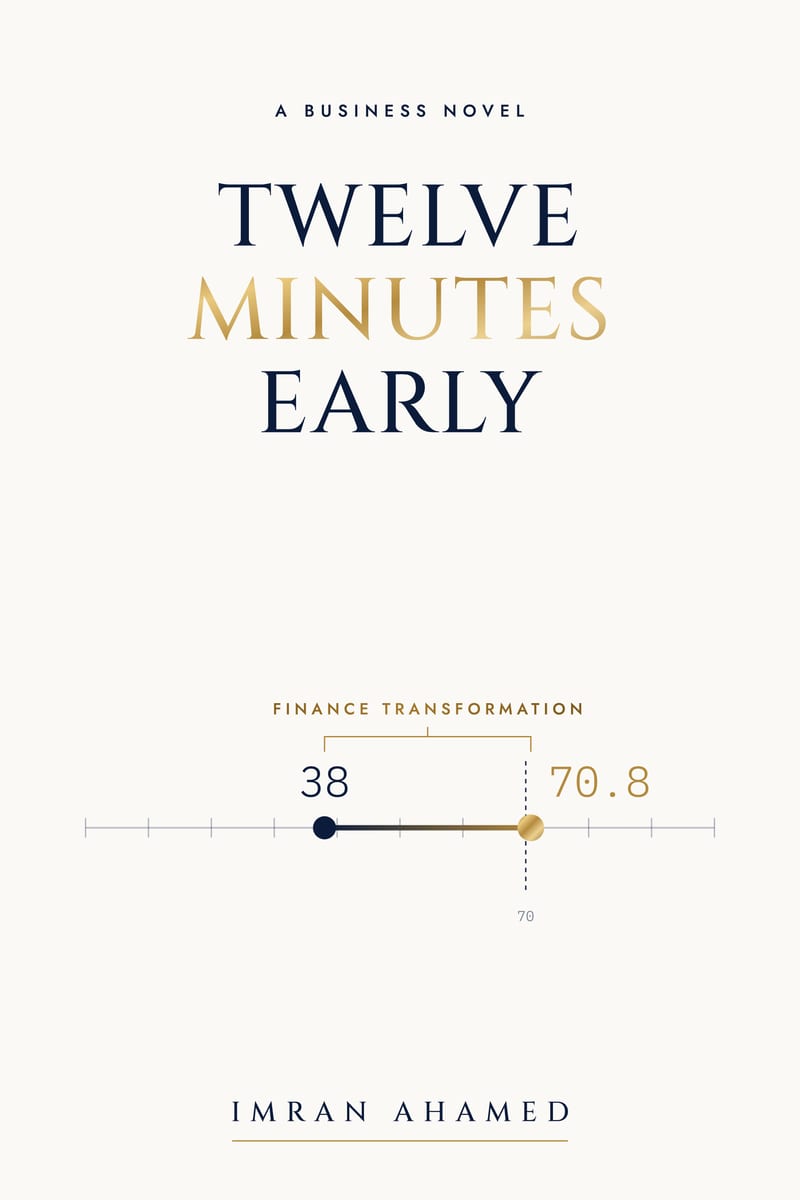
A company preparing to list on the stock market scores 38 out of 100 for readiness, against a line of 70 set by its listed peers. This is what it takes to close the gap, and who pays for it.
Get the newsletter for news about the book.
- Genre
- Business novel
Twelve Minutes Early is a novel about the finance transformation that follows: what it costs, who pays for it, and the question that changes everything once somebody finally asks it.
“This company’s financial reporting runs on a structure no living person has a map of.”
Diana Osei, CFO, FicFin
The book follows FicFin Inc. from that first score through the build, the waves of change and the proof, told by the people who lived it.
The book includes a Who’s Who of everyone in it, a glossary of terms and a reader’s guide with questions for discussion, written for book clubs, leadership programs and finance teams.
This is a work of fiction. All companies, including FicFin Inc. and Vantage Point Advisory, and all characters, figures and events are invented. It is the author’s independent work, written in a personal capacity, and is not connected with any current or former employer or client.
The score, explained
Why 38, and why 70?
What is being scored. FicFin Inc., a $4.7 billion building-materials group, has promised its people a stock market listing in 2028. The score measures whether its finance function is ready to work the way a listed company's must, across six areas from reporting and controls to investor relations.
Who scored it, and how. The CFO, Diana Osei, built the assessment quietly over two years, from documents the company already produced: close calendars, status emails, years of auditors' letters and a licence audit of its spreadsheets. She interviewed no one.
Why the line is 70. Before scoring FicFin, she scored four listed peers from their public filings and set the bar from them, so she could not tune the scale to the answer she wanted. The line of 70 comes from how those listed companies scored.
Why 38. It is the average of six scores, each out of 100. FicFin sits below the line on every one of them, and furthest below on reporting and controls.
- Financial reporting quality and speed29
- Internal controls and governance31
- Finance operating model scalability41
- Technology and data integrity34
- Treasury and working capital38
- Investor relations readiness52
- Overall38
Overall is the average of the six (37.5, reported as 38). The gold mark is the line of 70.
What 38 looks like in practice
- 23open control gaps, and two material weaknesses
- 1.9%of revenue spent on finance, against 0.9% at listed peers
- 31%of the monthly close spent on rework
- 900+linked spreadsheets holding the numbers together
From Chapter 1, so nothing here gives the story away. FicFin and everyone in it are fictional.
The story in four parts
- Part One: The Score
- Part Two: The Build
- Part Three: The Waves
- Part Four: The Proof
Key themes
Knowledge in one head
For fourteen years the controller has said there are about eleven exceptions. Nobody has asked which.
Controls that are really people
Mistakes get caught, always by the same two people, and no written step says anyone should.
Measuring honestly
The CFO scores four listed peers before her own company, so she cannot tune the scale to the answer she wants.
Who it is for
- Finance teams and finance leaders
- Leadership programs
- Book clubs